
CAPTURE
At the moment
of the decision.
Tzun records what the AI recommended, what the person decided and why, the exact time, and which model produced the recommendation — and the person signs it with a passkey on their own device.
Evidence infrastructure for AI decisions
A record made the moment a person decides — sealed, so no one can quietly change it later.
Not the vendor. Not us.
From a decision in the moment
to evidence that stands on its own.
CAPTURE
Tzun records what the AI recommended, what the person decided and why, the exact time, and which model produced the recommendation — and the person signs it with a passkey on their own device.
SEAL
The five are locked together under one cryptographic seal. From that point on nobody can change any part of it without the change showing — including us.
VERIFY
A court, a regulator, or the person the decision was about can test the seal themselves. They do not have to take the company’s word for it, or ours.
What is the decision itself: what the AI recommended, what the person decided and why, who signed, which model. When is the moment it was made. An ordinary log keeps the what and lets you rewrite the when. Tzun seals both together, so changing either one shows.
Tzun does not stop tampering.
It makes tampering undeniable.
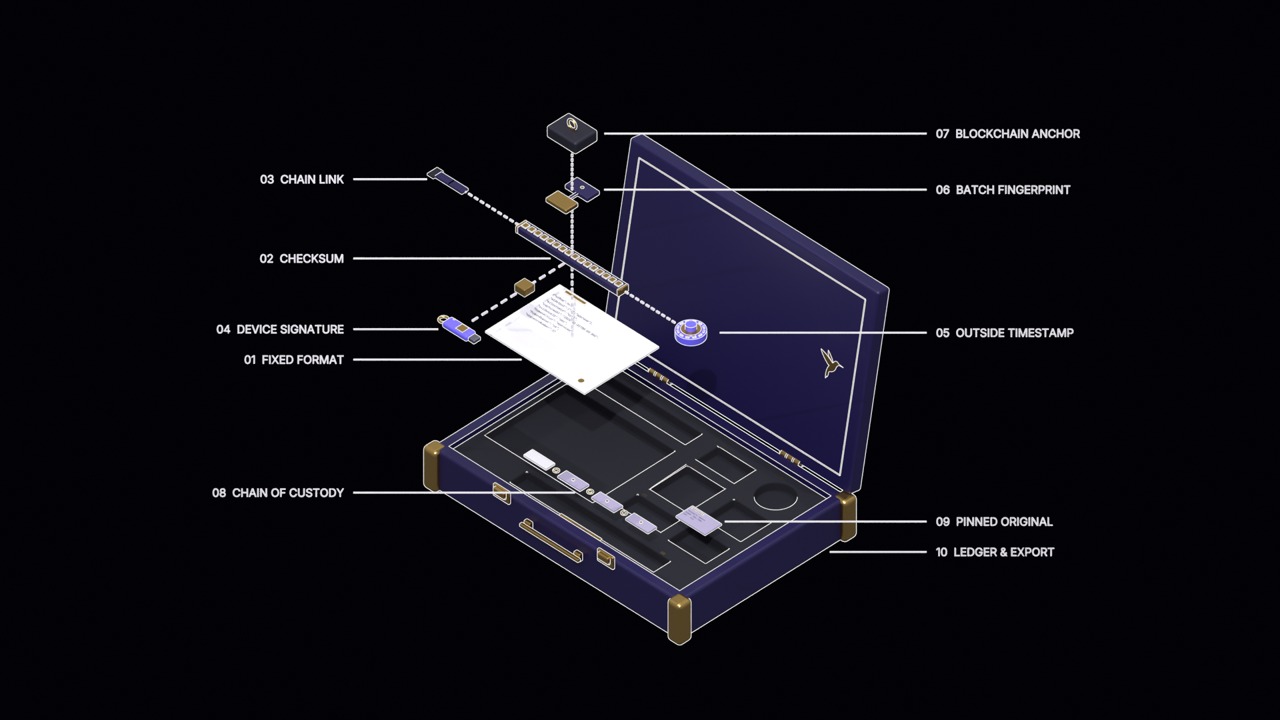
The five facts from the capture are one part of ten. The other nine are what make the record hold up — and each one can be verified independently, without taking our word for it.
A sealed case. From the outside, nothing to see.
RENDERED FROM THE SDK PIPELINE
Canonical bytes: the sealed fields written one fixed way, so the same decision always comes out the same.
A SHA-256 checksum: a short fingerprint of the record. Change any sealed field and the checksum changes.
A hash chain: each record is linked to the one before it, so the order is fixed the moment it is written.
A WebAuthn signature: the person who decided signs with a passkey on their own device. No password.
An RFC 3161 timestamp: an outside authority stamps the record’s fingerprint, proving it existed by then.
A Merkle batch: many records’ fingerprints are combined into one batch fingerprint that stands for them all.
The batch fingerprint is written to a public blockchain, where it is no longer ours to revise.
A hash-linked log: what happens to a record after capture is added as an entry sealed to the one before.
What was captured stays exactly as captured. Fixes are added on top; the original is never rewritten.
Every part is kept together, and an exported bundle carries everything an outside reviewer needs to check it.
Companies now use AI to help decide who gets hired, who gets a loan, whose treatment gets approved. Two questions follow, and they arrive together: did a real person make the call, and can anyone prove it?
Most cannot. The proof is notes and logs that somebody could quietly change — and a record the vendor could have edited is the first thing challenged.
A log will not answer it.
Calculating…Calculating…Interactive illustration. Your browser compares two SHA-256 fingerprints. Not a live Tzun record or Tzun’s own checker.
The same record works in any field where AI recommends and a person signs off.
Hiring is where the lawsuits and the measured harm already are. Tzun works with any AI, including autonomous AI agents.
PICK ONE TO SEE AN EXAMPLE
An AI tool ranks 812 applicants. A recruiter reviews the shortlist and advances the one ranked fourth.
If a rejected applicant sues, the record shows what the AI recommended, which model version produced it, and that a named recruiter made the call, when, and why. Sealed before anyone knew there would be a dispute.
A US federal court ruled an AI vendor that screens and ranks applicants can be sued directly, alongside the employer. The vendor’s risk is new. The employer’s was never in doubt.
1.1 Billion
Applications rejected through Workday,
per its own court disclosure.
3.4 Million
Applicants screened by one vendor’s AI in a Stanford study of hiring algorithms. The same people kept getting rejected.
It sits behind the systems already making these calls. Add it with the SDK, host it yourself, or use Tzun’s cloud. Nothing is replaced, and the workflow your team uses does not change.
Your systems. Your process.
TZUNFive facts. Sealed as one.
LIVE SDKIndependently verifiable.
Yours, not ours.Over twenty years in enterprise tech, at Oracle and LinkedIn, selling into enterprise buying committees, where general counsel always had a seat. Five years on the board of a legal services non-profit.
Three provisional patents filed April 2026. Tzun is one of 200 companies selected for the TechCrunch Startup Battlefield 200 at Disrupt, 13–15 October 2026.
A DECISION TODAY. EVIDENCE FOR WHAT COMES NEXT.
Tzun is live. It works with the systems you already have, and the records it writes are yours — verifiable without us.